Showing posts with label Matthew. Show all posts

Monday, August 3, 2009

Resistance is Futile

In Matthew 5:39, Jesus tells us:

But I say unto you, That ye resist not evil: but whosoever shall smite thee on thy right cheek, turn to him the other also.

Was Jesus aware of our Constitutional Right to Bear Arms when He said this? Is Jesus telling me to sell my gun collection? Does the Second Amendment not protect us from Governmental takeover? How can I stop the minions of evil from pouring into my home if I must not offer any resistance? Will Jesus post guards at my door to protect me? But how can they offer protection if they too cannot offer resistance? Are those who protect us, like law enforcement officers, really operatives of Satan, blatantly defying Jesus's directives with our own tax money?


What about our military? Does their preserving our freedom piss Jesus off because they're resisting the terrorists? Should we call them all back home so as not to go against His teachings? Were we wrong in resisting the spread of Communism? Should we have invited Stalin and his cronies here after World War II? And did we let Jesus down in the Second World War as well? In our effort to save the world from Fascism, did we plunge ourselves into sin? Was Marshal Pétain a model Christian for surrendering France to the Nazis? Should the French rightfully be called the Chosen people?

And what exactly does Jesus mean by resistance? Is the deadbolt on my front door not a means of resisting? Are my family and I living in sin every night when we bolt our door? Will I have to answer for this at the Judgement Day? Should I leave the front door open as proof that I'm offering no resistance? Should we open the borders as well? How can we call ourselves a Christian nation when we have controls in place to resist the illegal entry of evil? What must Jesus think of us?

How about sports? Are defensive positions sinful? Should the defensive line open up and allow the ball to be carried over the goal line with no resistance? Would Jesus then be cheering from His Throne? Is defensive driving wicked? If someone wishes to run me off the road, should I offer no resistance? Should I simply drive in a ditch to preserve my sole? Should I cancel my appointment for a flu shot? If I offer resistance to the virus, am I in danger of the eternal fires of hell? Should we lay to waste the clinics offering such shots?

How about Jesus's directive to turn the other cheek when we are smitten? Which cheeks are being referred to here? Or is "cheek" just a metaphor? Should we always offer more to whosoever shall smite us? When the Japanese smote our Pacific Fleet, should we have offered our Atlantic Fleet as well? When the terrorists knocked down the World Trade Center, should we have led them to the Empire State Building? If the opposing team scores a touchdown, must we offer them a field goal too?

Or is Jesus simply telling us to never be in a position where we're on the defensive? He gave no restrictions about being on the offensive! Are we morally obligated to launch preemptive strikes? Is God on our side only while we're winning? If we strike first, are our opponents morally obligated to offer us no resistance? Should we walk down the street kicking ass before our asses are kicked? Should we kick the other cheek as well when it's turned to us?

Sunday, August 2, 2009

Family Feud

I've heard it said that the problems with families today is that they don't know Jesus. With that in mind, I decided to look up Jesus's teachings on the family. Luke and Matthew both have some memories on that subject to share with us. In Luke 12:51-53, Jesus says:

51 Suppose ye that I am come to give peace on earth? I tell you, Nay; but rather division:

52 For from henceforth there shall be five in one house divided, three against two, and two against three.

53 The father shall be divided against the son, and the son against the father; the mother against the daughter, and the daughter against the mother; the mother in law against her daughter in law, and the daughter in law against her mother in law.


Are those words not a bit harsh! Was Luke hitting the bottle on that day? Did he write things down incorrectly? Well, perhaps not, for Matthew remembers the same thing. According to Matthew 10:34-36, Jesus said:

34 Think not that I am come to send peace on earth: I came not to send peace, but a sword.

35 For I am come to set a man at variance against his father, and the daughter against her mother, and the daughter in law against her mother in law.

36 And a man's foes shall be they of his own household.


Different words but the same meaning. So then, how am I to follow the word of Jesus? What division is Jesus talking about? Is this a mathematical problem or is he dividing families? If it's families that will be against each other, could we just play something nice like touch football? Or maybe team Monopoly? How about dueling banjos?

Must I always have three against two? Could I not even the sides up by inviting another into this fracas? What do I do if my family consists of more or less than five? What about the father-in-law? Why is it that he is apparently allowed to escape unscathed? Can he not join in to make it three against three? Or does Jesus consider him untouchable? Can I maybe invite some other in-laws? Could I perhaps get some cousins to wait on the sidelines in case someone needs a bathroom break? Am I allowed wildcard players?

What about the mother? Why has she been given the worst deal? She has not only the daughter against her, but the mother-in-law as well! Must the rivalry always be divided along the lines of gender? Jesus has dictated that it shall be females against females and males against males, but are we allowed to make deals and trade players from time to time? Can we have some days when it's father against daughter and mother against son? Could the mother-in-law sort of play the field, helping the underdog?

But what about this sword that Jesus will send? Will it be one of those soft, styrofoam ones? Or will it be a rapier or a sabre, or possibly something heavy like a longsword? Should it be the latter and it prove too heavy for someone like the mother-in-law, can I use a designated hitter?

Couldn't someone get hurt if it's a real sword? Is that the whole idea? Luke seems to remember Jesus saying something else, in Chapter 14 Verse 26:

If any man come to me, and hate not his father, and mother, and wife, and children, and brethren, and sisters, yea, and his own life also, he cannot be my disciple.

Won't all that hatred ruin the Monopoly game? How can I make a deal about Park Place with someone who hates me? Must I hate everyone at the same time? Can I even things out by loathing one and therefore just being piqued with another? Do I have to hate the players on my own team too? How can I plan any strategy with my daughter-teammate if I know she hates me? Maybe she's planning some strategy against me? And what if I hate my son and take a sword to him? Will that be child abuse or is there a religious exemption? Is Jesus saying that spanking is cool? How is a victor determined? Is it last man standing? Are those killed in these family feuds dictated by Jesus granted automatic entry into heaven?

And what about hating my own life? Must I hate myself, or just the life? Must I hate it to the point of taking it? If we all want to take our lives to be Jesus's disciples, then isn't this advocating mass suicide of the whole human race? Is this how it's all supposed to end? Is this the only way to be a disciple of Jesus? Were Peter and all those others full of hatred too? Is that why they couldn't agree and allowed Paul (Saul) to take over? But if I hate my life, why would I care if it's saved by Jesus? Is this not a paradox?

Wednesday, July 29, 2009

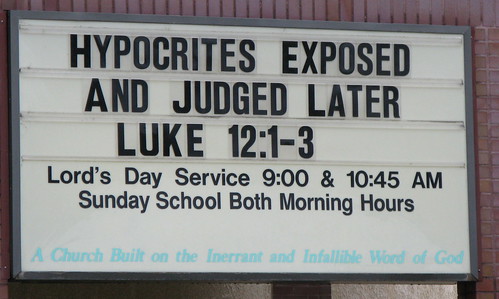
O Come All Ye Hypocrites

Week after week, those who call themselves "blessed" invite me to come pray at their church. But with so many different Christian churches, how can I tell which one God approves of? So I searched the Bible for Jesus's teachings on praying in church. In Matthew 6:5-6 Jesus says:

5 And when thou prayest, thou shalt not be as the hypocrites are: for they love to pray standing in the synagogues and in the corners of the streets, that they may be seen of men. Verily I say unto you, They have their reward.

6 But thou, when thou prayest, enter into thy closet, and when thou hast shut thy door, pray to thy Father which is in secret; and thy Father which seeth in secret shall reward thee openly.


So what's Jesus trying to tell us? Do people only go to church to be seen by other people? Are their only thoughts on what others think of them? Do they get big rewards for praying in front of others? There sure is a lot of rewarding going on every Sunday from what I can see! Is this why America is the world's richest nation? Is this how people are surviving the recession? Why do they not share their rewards?

Why do people do this if Jesus spoke against it? Do they seek their rewards at church because church income isn't taxed? Why are the churchgoers so proud of what they do if Jesus isn't? Why does the Church not teach the people the words of Jesus? Better yet, why can the people not read it for themselves?

So is Jesus saying that I should only pray in the closet? What will God think when I come out of the closet? Does God not speak out against homosexuals in the Old Testament? Should I take a girl in the closet with me so God will know I'm straight? What all does my Father see in secret? Does He work with the CIA? MI6? KGB? Mossad? What kind of open reward will I receive? Will I be taxed on it? Does the IRS see in secret too?

Would Jesus be pissed at me if I went to church for the big rewards sometimes? Is Jesus more tolerant of the grand reward seekers during the recession?

Tuesday, July 21, 2009

The Many Last Words of Jesus

Last words of famous people are always important. Look at Humphrey Bogart's dying statement of, "I should never have switched from Scotch to Martinis." Or Winston Churchill's, "I'm bored with it all." And of course Pancho Villa, who left us with the words, "Don't let it end like this. Tell them I said something."

But throughout history, whose last words could be more important than those of Jesus Christ? With that in mind, I sought His last words in the New Testament. The first book of the New Testament is Matthew. Chapter 37 of Matthew speaks of the Crucifixion, and in verse 46 we read:

And about the ninth hour Jesus cried with a loud voice, saying, Eli, Eli, lama sabachthani? that is to say, My God, my God, why hast thou forsaken me?

Fortunately Matthew was kind of enough to take the time to translate. However, this was rather disappointing. Jesus died on the cross with no parting advice - just a question to God. Matthew doesn't even tell us if God answered. I think it would have been pretty interesting to hear God's reply. I mean, if He forsake His Son, I'd like to know what to do so He doesn't forsake me too!

The next verses go on about some people getting confused and thinking Jesus was calling for Elias. Were these English speakers who couldn't understand the native language? Why couldn't Matthew translate for them too?

Next I went to Mark. Mark got to the Crucifixion in only 15 chapters. Mark 15:34 says the same thing as Matthew 37:46. Unfortunately, Mark doesn't pay attention for an answer from God either. He also goes on about the same fools waiting for Elias to come to Jesus. Why were neither of these guys listening for God's reply?

The next book is Luke. Luke 23:46 tells us:

And when Jesus had cried with a loud voice, he said, Father, into thy hands I commend my spirit: and having said thus, he gave up the ghost.

Now what the hell is going on here? Luke heard something altogether different! Why didn't Luke hear Jesus's question about being forsaken? And why didn't Luke talk about the confused English speakers? Hadn't Luke been paying attention? Was he just making things up as he went along? Exactly how credible was the word of Luke? What about all the cool stuff that Linus says each year in "The Peanuts Christmas Special"? Things that we all know, like:

And the angel said unto them, Fear not: for, behold, I bring you good tidings of great joy, which shall be to all people.

For unto you is born this day in the city of David a Saviour, which is Christ the Lord.


That's from Luke Chapter 2, and none of the other gospels have that in them. Mark and John don't mention the birth of Jesus at all, and Matthew just gives it one line (Matthew 1:25) after getting bogged down with all the "begats." So was Luke just daydreaming during the First Christmas? Did he just made up a bunch of things later for us to use in holiday TV specials? Did he make up things about The Crucifixion too?

I turned to John to get some confirmation. John 19:30 says,

When Jesus therefore had received the vinegar, he said, It is finished: and he bowed his head, and gave up the ghost.

Where was John standing to hear only that? No mention of Jesus speaking to God at all - just His telling us that it's finished. Does this mean that John has no credibility either? What about John 3:16, where John tells us:

For God so loved the world, that he gave his only begotten Son, that whosoever believeth in him should not perish, but have everlasting life.

People have made fortunes putting this on signs and billboards from New Jersey to California, but now the credibility of the guy who wrote is in question. What if John only made that up? Think of all the empty signs and lost income if that gets out!

On the other hand, how do I know that I can trust Mark and Matthew? Just because their stories match doesn't mean that they're right. Maybe they didn't make it to The Crucifixion in time. Maybe they just collaborated on some fabrication together. Or maybe one wasn't paying attention. Maybe he fell asleep, or was flirting with some girls or something. So maybe he copied off of the other.

The big question here is which gospel do we believe? Should I doubt all four until I know the truth? With something so important, couldn't they have sat down together and made sure their stories matched? Were they in some kind of competition, or what? Was creative writing a big thing back then? Did they get a prize for the most original story? Couldn't someone have sat down and edited this later? Isn't it an editor's job to find errors? God was writing back in Genesis; why didn't He edit out the errors in the gospels?

Monday, July 20, 2009

Cast Away Offensive Body Parts

Today I decided to go to the New Testament for guidance. I saw that Matthew and Mark both have some advice on how to stay out of hell (even if it means you won't be going to heaven intact). Matthew writes about it twice, in Chapters 5 and 18, so I'll quote one of his passages here. This is Matthew 5:29-30 :

29. And if thy right eye offend thee, pluck it out, and cast it from thee: for it is profitable for thee that one of thy members should perish, and not that thy whole body should be cast into hell.

30. And if thy right hand offend thee, cut it off, and cast it from thee: for it is profitable for thee that one of thy members should perish, and not that thy whole body should be cast into hell.


It seems like this could have been summed up in one verse, by starting out with "And if thy right hand or right eye offend thee . . . . " But who am I to question such things. Mark wrote the same way (Mark 9:43-47) and even added a right foot in there, so obviously this is the right way to express it.

One thing that isn't mentioned here is how we're supposed to function once we've started cutting and casting away. What if my right hand starts getting offensive with me? Neither I nor anyone I know have performed any amputations, so where do I go for guidance? Won't there be a lot of blood involved? Can I get a doctor to do it? Is the cutting off and casting away of limbs covered by most insurance policies?

Once I cut my offensive hand off, how am I supposed to do things like open a jar of pickles? Can I ask my neighbor for help? But with my right hand cast away, how could I hold the jar and knock on my neighbor's door at the same time? And once I've cast away my right hand, what do I do if my left hand starts offending me? Does insurance cover prosthetic limbs when the real ones have been cut off for religious reasons?

What about the eye thing? "Plucking" sounds like something reserved for a chicken or a Thanksgiving turkey. Is plucking an eye just as simple? Will I have to retake my vision test at the DMV afterwards?

And what do I do if some body part of another person is offending me? If someone at work has an offensive nose, can I cut if off and cast it away for him? Would this be proper under the pretext of keeping him out of hell? What about someone with offensive breath? What if someone offends me in thought? Are there any limitations that must be observed here, or can I just go plucking, cutting and casting away unrestrained, as long as such actions are sanctioned by God?